Buying a foreclosed home through a Franklin County Sheriff Sale can be an excellent opportunity to purchase real estate below market value. However, many first-time buyers lose money because they don’t understand how sheriff sales work, where to find official listings, what documents are required, or how the payment process works after winning an auction.
Unlike a traditional home purchase, sheriff sales follow a court-supervised foreclosure process. Buyers are responsible for researching the property, understanding the auction rules, and meeting strict payment deadlines. Missing even one requirement could result in losing your deposit or the property itself.
What Is a Franklin County Sheriff Sale?
A Franklin County Sheriff Sale is a public auction where foreclosed real estate is sold under a court order. Most properties reach a sheriff sale after the homeowner defaults on mortgage payments and the lender successfully completes the foreclosure lawsuit.
Once the court issues a foreclosure judgment, the property is scheduled for sale through the Franklin County Sheriff’s Office. Since Ohio now conducts these auctions online, buyers no longer need to attend a courthouse auction in person.
The highest qualified bidder who satisfies all payment requirements becomes the purchaser after the court confirms the sale.
How Does the Franklin County Sheriff Sale Process Work?
Understanding the complete process before placing a bid helps reduce financial risk.
The process generally follows these stages:
- The lender files a foreclosure case.
- The court approves the foreclosure.
- The property is appraised.
- The Sheriff schedules the auction.
- The property is advertised publicly.
- Buyers register on the official auction website.
- Qualified bidders participate in the online auction.
- The winning bidder submits the required deposit.
- The court reviews and confirms the sale.
- The remaining balance is paid.
- The Sheriff’s Deed is issued to the new owner.
Although the process appears straightforward, each stage includes legal requirements that buyers should understand before bidding.
Where Can You Find Franklin County Sheriff Sale Listings?
One of the most common questions buyers ask is:
“Where do I search Franklin County foreclosure properties?”
The official listings are published through the Franklin County Sheriff’s online auction platform.
Each listing typically includes:
- Property address
- Case number
- Parcel number
- Plaintiff (usually the lender)
- Property appraisal
- Opening bid
- Auction date
- Property photographs (when available)
- Legal description
- Court information
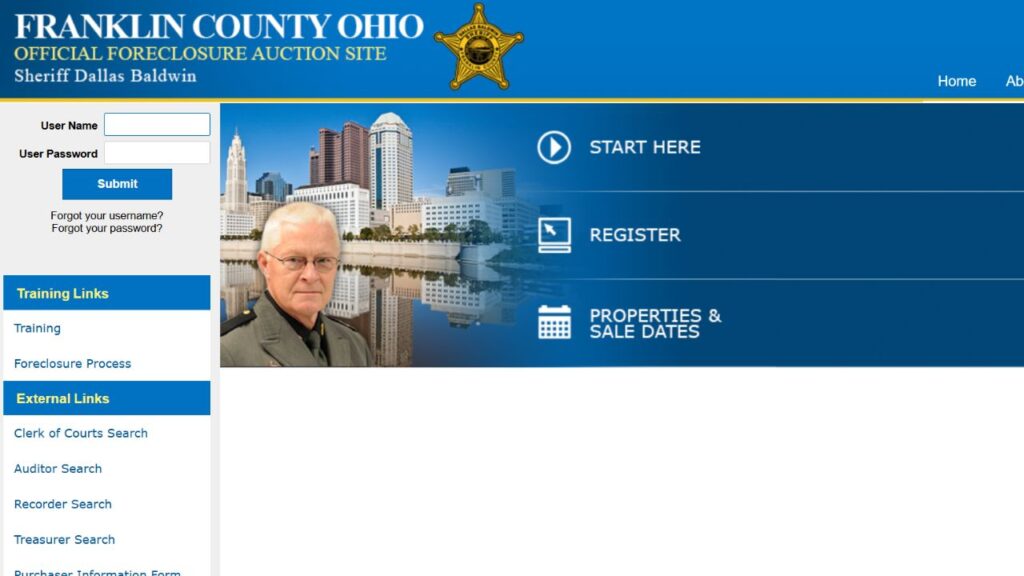
Avoid relying solely on third-party foreclosure websites. They often display outdated or incomplete information. The official auction website always provides the most accurate schedule and bidding details.
Who Can Participate?
Most sheriff sales are open to the public.
You generally do not need a real estate license or investment company to participate.
You may bid if you:
- Are at least 18 years old
- Complete bidder registration
- Agree to the auction terms
- Provide the required information
- Can pay the required deposit if you win
Many first-time buyers successfully purchase homes through sheriff sales after completing proper research.
Step 1 – Research the Property Before Registering
Never bid simply because a property appears inexpensive.
Experienced investors often spend several hours researching each property before placing their first bid.
Start by reviewing:
Property Location
Visit the neighborhood if possible.
Check:
- Nearby homes
- Schools
- Crime rates
- Commercial development
- Road access
- Flood zones
A low purchase price does not always make a good investment if the surrounding neighborhood has declining property values.
Review County Property Records
Search county property records to verify:
- Owner information
- Parcel details
- Tax history
- Building size
- Lot dimensions
- Previous transfers
- Assessed value
These records help confirm that the property matches the auction description.
Estimate Market Value
Compare the property with recently sold homes in the same neighborhood.
Look at:
| Factor | Why It Matters |
|---|---|
| Living area | Determines comparable value |
| Bedrooms | Influences resale price |
| Bathrooms | Affects buyer demand |
| Garage | Adds value |
| Lot size | Important for investors |
| Property condition | Determines repair budget |
Never assume the appraised value equals the current market value.
Step 2 – Check Existing Liens and Financial Obligations
This step separates experienced buyers from beginners.
Many buyers mistakenly believe every debt disappears after foreclosure.
That is not always true.
Before bidding, research whether the property has:
- Delinquent property taxes
- Municipal assessments
- Utility balances
- HOA obligations
- IRS liens
- Federal liens
- Judgment liens
Some obligations may remain with the property even after the sheriff sale.
Hiring a title company or real estate attorney to perform a title search can save thousands of dollars later.
Step 3 – Register for the Online Auction
Franklin County conducts sheriff sales through an online auction platform.
Before bidding, you’ll need to create a bidder account.
During registration, you may be asked to provide:
- Full legal name
- Government-issued photo ID
- Residential address
- Email address
- Phone number
- Electronic acceptance of auction terms
Double-check your registration details because errors can delay approval or create problems after winning an auction.
Step 4 – Understand the Deposit Requirements
Every winning bidder must submit a deposit.
The required deposit depends on the final sale price.
Generally, the deposit follows Ohio foreclosure sale requirements:
| Sale Price | Deposit Required |
| Up to $10,000 | $2,000 |
| $10,001–$200,000 | $5,000 |
| Over $200,000 | $10,000 |
Failure to submit the required deposit within the specified timeframe may result in cancellation of the sale and possible forfeiture of bidding privileges.
Because payment deadlines are strict, buyers should arrange their funds before participating in the auction.
Step 5 – Complete the Required Purchaser Forms
Winning the auction is only part of the process.
After the sale, buyers may need to complete several documents before ownership can be transferred.
Common forms include:
Purchaser Information Form
This form confirms the buyer’s legal information and mailing address for court records.
Conveyance Information Form
The conveyance form is used during the property transfer process and helps prepare the official deed.
Rental Registration Form (If Applicable)
If the property will be used as a rental or local regulations require registration, additional documentation may be necessary before occupancy or leasing.
Completing these forms accurately helps prevent delays in court confirmation and deed preparation.
What Happens After You Win the Auction?
Many buyers believe they become the owner immediately after placing the highest bid.
That is not how the process works.
After the auction closes:
- Your winning bid is reviewed.
- The required deposit is verified.
- The court reviews the sale.
- The judge confirms the sale.
- The remaining balance becomes due.
- Once payment is completed, the Sheriff’s Deed is prepared.
- Ownership officially transfers after the deed is recorded.
Because several legal steps occur after the auction, buyers should remain patient and continue monitoring all payment deadlines and court notices.
Court Confirmation of the Sale
After payment requirements are satisfied, the sale is submitted to the court for confirmation.
The judge reviews whether:
- The foreclosure process followed Ohio law.
- The auction was conducted correctly.
- Payment requirements were met.
- No legal objections remain.
Only after the court signs the confirmation order does the transaction move toward closing.
This is one of the biggest differences between a sheriff sale and a traditional real estate purchase.
Step 8 – Receive the Sheriff’s Deed
Once the court confirms the sale and all funds are received, the Franklin County Sheriff’s Office prepares a Sheriff’s Deed.
The deed is then recorded with the county recorder, officially transferring ownership to the purchaser.
After recording, the buyer becomes the legal owner of the property.
Keep copies of:
- Sheriff’s Deed
- Court Confirmation Order
- Payment Receipts
- Closing Documents
These records may be needed later for refinancing, selling the property, or resolving title questions.
Can You Inspect the Property Before Bidding?
This is one of the most common questions first-time buyers ask.
In most cases, no.
Sheriff sale properties are sold “As Is, Where Is.”
That means:
- No repair guarantees
- No seller disclosures
- No home warranty
- Limited or no interior inspection
Because many homes are still occupied, buyers often cannot enter the property before the auction.
Instead, perform as much research as possible by:
- Visiting the neighborhood
- Inspecting the exterior
- Reviewing aerial maps
- Studying county records
- Estimating repair costs based on visible conditions
Never assume the inside of the home is in good condition.
Do Existing Liens Disappear After the Sale?
Many new investors believe every debt attached to the property disappears after foreclosure.
That assumption can be expensive.
Depending on Ohio law and the type of lien, some obligations may survive the sheriff sale.
Potential obligations include:
| Possible Obligation | May Remain After Sale? |
|---|---|
| Property Taxes | Sometimes |
| IRS Tax Liens | In certain situations |
| Municipal Assessments | Possible |
| Utility Charges | Depends on local rules |
| HOA or Condo Fees | May continue |
| Environmental Liens | Possible |
Before bidding, order a professional title search or work with a real estate attorney. Spending a few hundred dollars on due diligence can save thousands later.
Should You Buy Title Insurance?
Although not always required, many experienced investors purchase title insurance after acquiring a sheriff sale property.
Title insurance can protect against issues such as:
- Unknown ownership claims
- Recording errors
- Undiscovered liens
- Boundary disputes
- Clerical mistakes in public records
If you plan to keep the property long-term or sell it in the future, title insurance is usually a wise investment.
What If Someone Is Still Living in the Property?
Not every sheriff sale property is vacant.
The home may still be occupied by:
- The former owner
- Tenants
- Family members
- Unknown occupants
Winning the auction does not automatically give you the right to move in immediately.
If occupants refuse to leave voluntarily, additional legal procedures may be required before possession can be obtained.
Avoid changing locks, shutting off utilities, or removing belongings without following Ohio law.
If necessary, consult a qualified real estate attorney before taking action.
Common Mistakes Buyers Make
Even experienced investors occasionally make costly mistakes.
Here are the most common ones:
Bidding Without Research
A low opening bid does not always mean a good investment.
Ignoring Repair Costs
Many foreclosed homes require significant repairs.
Always estimate renovation expenses before bidding.
Skipping a Title Search
Unexpected liens can dramatically increase your total investment.
Missing Payment Deadlines
Sheriff sales follow strict timelines.
Late payments can result in cancellation of the purchase.
Emotional Bidding
Never compete simply to “win.”
Set a maximum budget before the auction starts and stick to it.
Expert Tips Before Buying
If this is your first sheriff sale purchase, these best practices can reduce risk:
- Research at least five comparable sales.
- Estimate repair costs before bidding.
- Verify unpaid taxes.
- Check zoning restrictions.
- Review flood maps.
- Understand neighborhood trends.
- Budget for insurance and maintenance.
- Keep emergency funds available.
- Hire a title company if you’re unsure about liens.
- Never invest money you cannot afford to tie up during the court confirmation process.
Buying fewer properties with thorough research is usually better than purchasing multiple properties without proper due diligence.
Final Thoughts
Franklin County Sheriff Sales can provide excellent opportunities to purchase residential and investment properties, but success depends on preparation not luck.
Before placing your first bid, make sure you understand the auction process, research every property thoroughly, verify potential liens, estimate repair costs, and prepare your finances in advance. Taking the time to perform proper due diligence can help you avoid expensive surprises and make more confident investment decisions.
Whether you’re buying your first home or expanding a real estate portfolio, approaching sheriff sales with a clear strategy and realistic expectations is the best way to protect your investment and increase your chances of long-term success.
Frequently Asked Questions
Can anyone participate in a Franklin County Sheriff Sale?
Yes. Most sheriff sales are open to the public, provided the bidder completes registration and complies with the auction terms.
Is financing allowed?
Because payment deadlines are short, many buyers use cash or pre-arranged financing. Traditional mortgages may not close quickly enough.
Are sheriff sale homes cheaper than market value?
Sometimes. However, competitive bidding can increase the final sale price, so there is no guarantee of getting a bargain.
Can I inspect the inside of the property?
Usually not. Most sheriff sale homes are sold as-is, and interior access is generally unavailable before the auction.
When do I become the legal owner?
Ownership transfers after the court confirms the sale, the remaining balance is paid, and the Sheriff’s Deed is recorded.
Should first-time buyers hire an attorney?
If you’re unfamiliar with foreclosure law, title issues, or sheriff sales, professional legal advice can help reduce risk and prevent costly mistakes.