
Franklin County Auditor Guide(Property Taxes, Records & Services)
If you are searching for property records or financial data in the region, the Franklin County Auditor office is your primary resource. You can easily perform a Franklin County Auditor property search or an owner search directly through their official website at franklincountyauditor.org. This portal provides comprehensive details regarding property assessments and up-to-date Franklin County assessment information.
Furthermore, you can utilize the Franklin County Ohio check register to review the county’s financial transactions and public records. For those requiring in-person assistance, the Franklin County Ohio auditor office is conveniently located at 35 W Spring Street, Columbus, OH. Whether you are navigating the Franklin Auditor site for tax records or conducting a specific Franklin auditor property search, this platform serves as an essential tool for all your fiscal and property-related inquiries.
What Does the Franklin County Auditor Do?
The Franklin County Auditor serves as the chief fiscal officer for the county, managing a wide range of financial responsibilities that directly impact Columbus residents and local property owners. From assessing real estate values to overseeing county expenditures, understanding these core functions helps citizens better utilize available public resources, file timely tax relief programs, and access critical Franklin County property records.
Property Assessment And Records
The Franklin County Auditor’s office is responsible for maintaining accurate property records for all real estate parcels across the county. Under Ohio state law, this includes conducting regular county-wide property reappraisals every six years (Sexennial Revaluation) with statutory updates every three years (Triennial Update) including the ongoing 2026 Triennial Property Value Update where tentative new values will be released this June 2026 with property value review sessions open until September 2026 to ensure fair market valuations that accurately reflect the current local housing market.
These assessments form the basis for property tax calculations that fund essential county services, schools, and local government operations.
Tax Administration
Beyond assessments, the Franklin County Auditor administers various real estate tax programs, including the Homestead Exemption for senior citizens and disabled residents, which can significantly reduce property tax burdens for eligible Ohio homeowners. Additionally, the Auditor handles applications for the Owner-Occupancy Tax Reduction and CAUV (Current Agricultural Use Value) to ensure local residents receive every tax saving they qualify for.
Managed by financial services, the official Franklin County Auditor’s office processes vital property tax distributions to local municipal governments, public libraries, townships, and community Columbus school districts that rely on real estate tax revenue to operate essential public services.
Recorded Documents And Transfers
The Franklin County Auditor maintains official real estate transfer records for property ownership changes, while collaborating with the Recorder’s Office which handles deeds, mortgages, and legal liens that establish ownership throughout Ohio.
When real estate changes hands, the Franklin County Auditor’s office processes the official conveyance forms, collects the required transfer fees, and instantly updates the county’s public tax maps to ensure an accurate, up-to-date chain of title for all new property owners.
Need To Search Property Records?
Access comprehensive property information including ownership history, tax values, and recent sales data through the official property search tool.
How To Use Franklin County Property Search Tools
The Franklin County Auditor’s public property search system provides highly detailed information about real estate parcels throughout the entire county area. Learning to navigate this online mapping and property lookup tool effectively can save hours of research time and provide crucial market valuation insights for local homeowners, real estate buyers, and investors looking for public county records.
Search Methods Available
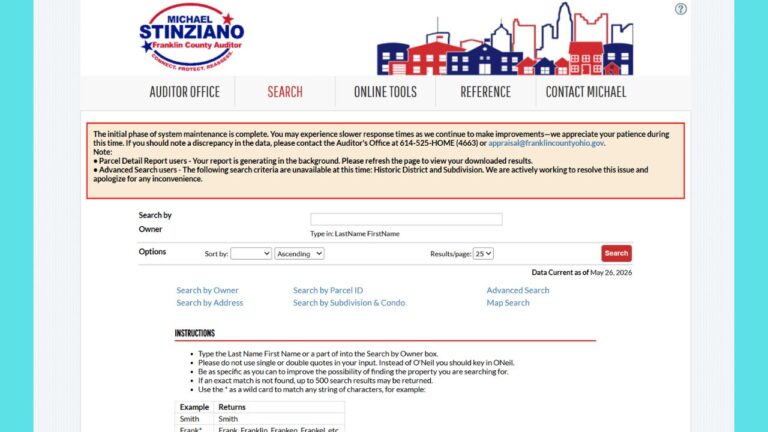
The Franklin County property search system offers multiple ways to find information:
- Search by address (most common method)
- Search by parcel number (most precise method)
- Search by owner name (useful for multiple properties)
- Search by neighborhood or area (for market research)
Each search method serves different needs, with parcel number searches providing the most direct route to specific property information.
Step-by-Step Property Search Guide
- Visit the Franklin County public property search portal online.
- Select your preferred search method (address, parcel, owner)
- Enter the required information in the search fields
- Review the list of matching properties if multiple results appear
- Click on the specific property to view detailed information
Franklin County Auditor Property Search Interface
Information Available Through Property Search
Property Details
- Year built and improvement details
- Parcel number and legal description
- Property class and land use
- Lot size and building specifications
Valuation Information
- Current market value assessment
- Historical valuation changes
- Land value vs. improvement value
- Recent appraisal information
Tax Information
- Current tax year information
- Payment history and status
- Tax distribution breakdown
- Special assessments if applicable
Property Taxes in Franklin County OHIO
Property taxes represent a significant expense for homeowners and a crucial funding source for local services. The Franklin County Auditor’s office plays a central role in determining the base for these taxes through public property assessments and market valuations, which are used by local authorities to calculate final tax bills.
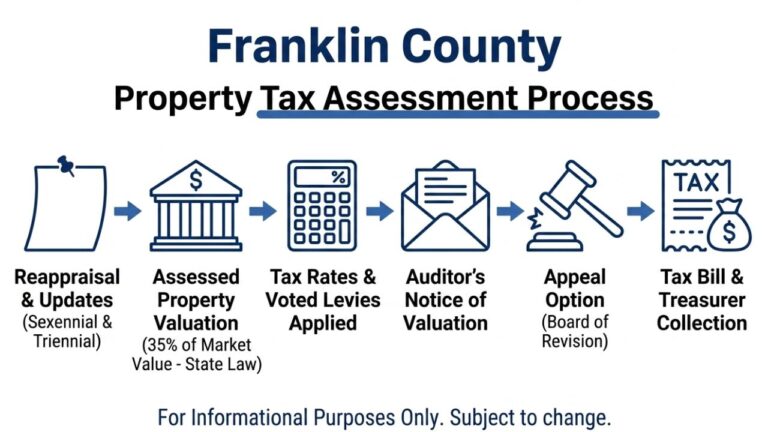
Assessment vs. Market Value
In Franklin County, properties are taxed based on their assessed value, which by Ohio state law is calculated as 35% of the total market value established during county valuations. For example, if a home has a certified market value of $200,000, its calculated assessed value would be $70,000 for property tax calculation purposes.
This distinction is important for understanding your tax bill and evaluating whether your property assessment accurately reflects current market conditions.
Reappraisal Cycles
The Franklin County Auditor’s office conducts a comprehensive reappraisal of all local properties every six years, along with a statutory triennial update at the three-year midpoint. These cyclical public assessments are designed to adjust property records so that valuations fairly reflect changing real estate market trends and neighborhood developments across the county.
Property owners should pay special attention to notices received during reappraisal years, as significant changes in valuation can impact tax obligations.
| Assessment Type & Frequency | Process & Evaluation Method | Impact on Property Taxes |
|---|---|---|
| Full Reappraisal (Every 6 years) |
A comprehensive review of all real estate parcels across the county to adjust market values to current conditions. | Can significantly change local property tax amounts depending on market shifts. |
| Triennial Update (Every 3 years) |
A statutory midpoint update utilizing localized neighborhood sales data statistics without physical property inspections. | Results in moderate baseline adjustments to align assessed valuations with current trends. |
| Annual Value Update (Yearly) |
Targeted adjustments strictly performed for new property constructions, structural additions, or major site improvements. | Directly affects only specifically modified properties by altering their individual value. |
Tax Exemptions and Reduction Programs
The Franklin County Auditor administers several programs that can reduce property tax burdens for eligible residents.
Homestead Exemption
The Franklin County Homestead Exemption program allows qualifying senior citizens (aged 65 and older) and permanently disabled homeowners to shield up to $25,000 of their home’s market value from local property taxation, resulting in significant annual savings.
For eligible veterans with service-connected disabilities, enhanced exemptions may be available.
Owner-Occupancy Reduction
Homeowners who occupy their primary residence in Franklin County may qualify for the Owner-Occupancy Reduction program, which provides a discount on their property tax bill. This statutory tax credit recognizes the difference between primary owner-occupied homes and real estate investment properties.
Applications must be submitted to the Auditor’s office with proper documentation to verify eligibility.
Check Your Tax Exemption Eligibility
Find out if you qualify for property tax reductions through homestead exemption or other programs offered by the Franklin County Auditor.
Accessing Recorded Documents and Transfer Information
The Franklin County Auditor’s office maintains public records for local property transfers and other important real estate documents. These cyclical updates help track legal ownership and document the historical timeline of real estate transactions throughout the county.
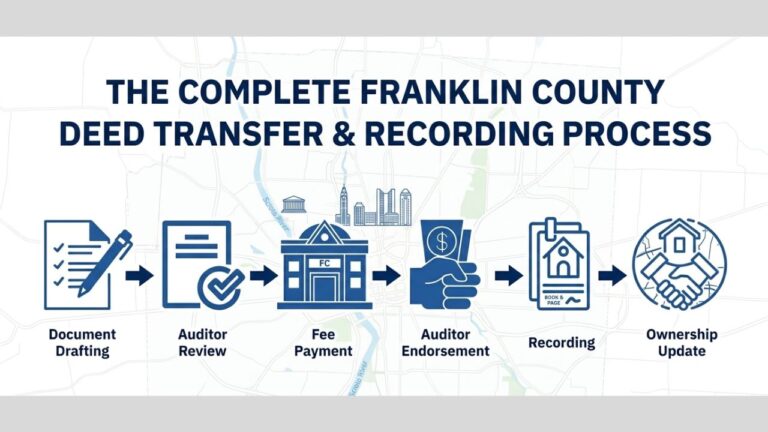
Types of Recorded Documents
Deeds
These are legal instruments that officially transfer real estate ownership from one party to another. The Franklin County Auditor’s office processes these deed transfers to update the county’s public property records and tax maps accordingly.
Mortgages
These formal loan agreements, like mortgages, create legal liens against real estate. In Franklin County, these documents are recorded to establish lender priority and provide public notice of the property encumbrance.
Liens
These financial claims against Franklin County properties for unpaid debts, taxes, or court judgments represent legal encumbrances that must be fully settled before the real estate can transfer with clear title.
How to Access Recorded Documents
Franklin County provides multiple methods to access recorded documents:
- Online search through the County Recorder’s database
- In-person requests at the County Administration Building
- Written requests by mail with appropriate fees
- Subscription services for frequent users like title companies
Property Transfer Process
When property changes hands in Franklin County, several steps must be completed:
- Preparation of deed and transfer documents by an attorney or title company
- Completion of a Conveyance Fee Statement declaring the property value
- Payment of transfer taxes based on the property’s sale price
- Recording of documents with the County Recorder
- Processing by the Auditor to update ownership records
Search Recorded Documents
Access public deeds, mortgages, liens, and other historical property records online through the Franklin County Recorder’s official electronic database to verify ownership status, active encumbrances, and local real estate filings.
Auto Title Division and General Accounting Services
Beyond local property-related functions, the Franklin County Auditor provides essential public services through specialized fiscal departments that serve area residents, consumer interests, and registered businesses throughout the entire county jurisdiction.
Auto Title Division
The Auto Title Division processes ownership documents for vehicles, boats, and other motorized equipment. Services include:
- Issuing titles for newly purchased vehicles
- Processing title transfers between buyers and sellers
- Replacing lost or damaged title documents
- Recording liens against vehicle titles
- Issuing watercraft and outboard motor titles
To obtain vehicle title services, residents must provide proper identification, proof of ownership, and payment for applicable fees.
General Accounting Department
The General Accounting Department manages the county’s financial operations with responsibilities including below services:
- Processing vendor payments and disbursements
- Issuing financial reports and statements
- Managing payroll for county employees
- Ensuring compliance with accounting standards
- Providing financial transparency for taxpayers
This department ensures that county funds are properly managed and accounted for, maintaining public trust in government operations.
Auto Title Services
Find locations, hours, and requirements for vehicle title services throughout Franklin County.
Frequently Asked Questions
Find answers to common questions about Franklin County Auditor services, property information, and tax processes.
How often does Franklin County reassess Property Values?
The Franklin County Auditor conducts a full general reappraisal of all local properties every six years (known as the sexennial reappraisal). Additionally, Ohio law mandates a statistical Triennial Update at the three-year midpoint to adjust values according to current real estate marketplace trends. Individual parcel values may also be adjusted annually based on physical changes such as new construction, property improvements, or demolition.
How can I appeal my property’s assessed value in Franklin County?
Property owners can file a valuation complaint with the Franklin County Board of Revision (BOR) between January 1 and March 31 each year. The appeal process requires completing DTE Form 1 (Complaint Against the Valuation of Real Property), which can be submitted via mail, email, or the Auditor’s online e-filing portal. To successfully contest the appraisal, you must provide supporting evidence, such as a recent independent appraisal, a signed purchase contract, or a certified closing statement.
What is the Homestead Exemption and who qualifies in Franklin County?
The Homestead Exemption is a statewide program that allows qualifying senior citizens (aged 65+) and permanently disabled homeowners to shield the first $29,000 of their home’s market value from local property taxation.
To qualify for this tax credit, applicants must own and occupy the property as their primary residence as of January 1 of the tax year. Additionally, new applicants must meet income means-testing, which requires their total household Modified Adjusted Gross Income to be $41,000 or less (based on the preceding year’s Ohio tax return).
How do I obtain a copy of a property deed?
Public deeds are obtainable through the Franklin County Recorder’s Office. You can search or request copies online using their public database, visit in person, or mail requests with appropriate fees.
When are property taxes due in Franklin County?
Franklin County property taxes are collected semi-annually. The first-half tax payments are due on February 28, and the second-half payments are due no earlier than July 20. Exact deadlines may shift to the next business day if they fall on a weekend, so it is best to verify dates annually via the Franklin County Treasurer’s website.
How can I find recent property sales in my neighborhood?
You can easily track recent neighborhood sales through the Franklin County Auditor’s online Real Estate Sales Dashboard or by using the Advanced Search tool on their property portal. These tools allow you to filter recent sales by street, zip code, or municipality. Additionally, the Auditor’s office publishes a Weekly Home Sales Report categorized by zip code, which is highly valuable for monitoring local real estate market trends and finding comparable property values.
How do I report property improvements to the Auditor?
Most structural property improvements are automatically reported to the Franklin County Auditor through building permits issued by your local municipality or township. However, if you have completed renovations or additions that did not require a formal permit, you can report them directly by contacting the Auditor’s Appraisal division via email at appraisal@franklincountyohio.gov or by calling 614-525-4663 (HOME) to ensure your public property record remains accurate.
What information do I need to transfer a vehicle title in Franklin County?
To transfer a motor vehicle title, you must visit a Franklin County Clerk of Courts Auto Title office with the following documents:
Original Ohio Title:
The seller must fully complete the “Assignment of Ownership” section on the back (including purchase price, buyer’s info, and odometer reading) signed in front of a Deputy Clerk or Notary Public.Application for Certificate of Title:
Fully completed and notarized.Valid Identification:
A government-issued photo ID (like a driver’s license or passport) for the applicant.Social Security Numbers:
Required for all parties involved in the transfer.Payment:
Title fees ($15 base fee plus applicable sales tax on the purchase price).
Independent Resource for Franklin County Information
This guide provides a comprehensive overview of the many essential services, tools, and public resources available through the Franklin County Auditor’s office. By understanding these programs and digital platforms, area residents and business owners can more effectively navigate real estate ownership, track property tax obligations, and seamlessly access official public records.
Explore More Franklin County Resources
Access additional information about property records, tax assessments, and other services provided by the Franklin County Auditor at official site.
FranklinCountyAuditor.Online is a privately operated website created to provide general information and helpful resources for residents of Franklin County, Ohio. We are not affiliated with the Franklin County government or the official Auditor’s Office. For official information, services, records, and filings, please visit the official county websites at franklincountyauditor.com or franklincountyohio.gov.